Hey folks, if you’ve ever worked with CNC turn-mill parts—whether you’re a product designer, a mechanical engineer, or a small business owner just getting your first prototype off the ground—you’ve probably asked yourself one question more times than you can count: “What’s the minimum order quantity (MOQ) here?” CNC Turn-Mill Parts

I’m Jake, I run a small CNC turn-mill parts shop out of Ohio—we’re not some huge faceless factory, just a team of guys who’ve been machining custom parts for 12 years, mostly for aerospace, medical, and outdoor power equipment clients. Every week, I get 5+ emails from people panicking because Google told them MOQs for custom machined parts are “1000 units minimum” and they only need 20 for a prototype run. I get it—most of the online info is generic, made for big manufacturing outfits that churn out 100k units a week, not someone testing a new valve design for a backyard invention or a student making a thesis prototype. So let’s break this down, straight from someone who actually runs the shop, no fluff, no jargon.
First, let’s clear up a myth: MOQs aren’t a random number we pull out of thin air. They’re tied to a bunch of factors that change every job, not some one-size-fits-all rule. I’ve had jobs with a MOQ of 5, and others where even 100 units are too few to turn a profit—and it all comes down to three big things: setup time, material waste, and part complexity.
Setup time is the biggest one, hands down. When you run a CNC turn-mill machine, it’s not like pressing a button on a 3D printer. First, I’ve got to load the tooling—drills, end mills, lathe inserts, whatever fits the turn-mill’s dual spindles. Then, I have to program the part: that 15-minute job? It took me 2 hours to code because the part has 3 radial holes, a curved face, and a thread that’s only 0.25 inches deep. Then there’s fixturing—securing the raw material so it doesn’t fly off at 10,000 RPM. If a job is a super simple, symmetric part—like a 2-inch aluminum bolt that just needs a thread and a face cut—setup time is 45 minutes. If it’s a medical implant component with 12 unique features, setup time is 8 hours. That fixed cost of setup doesn’t change, no matter how many parts you make. So if I spend 8 hours setting up for a part, I can’t charge you $5 a part for 5 units because that setup time alone would eat all the profit. If I make 100 units, I can spread those 8 hours across 100 pieces, so each part’s cost is way lower. That’s why MOQs jump for complex parts.
Next, material waste. CNC turn-mill parts are almost always made from solid stock—aluminum 6061, stainless steel 304, titanium, even brass for decorative parts. You don’t print them out of plastic filament; you turn a bar of metal on a lathe and mill the features. Let’s say you need a 1.5-inch diameter aluminum spacer. The raw material is a 1.5-inch round bar, 12 inches long. To make that spacer, I’m cutting off a 0.25-inch section from the bar. If you need 20 spacers, that’s 5 inches of bar cut off. If you need 100, that’s 25 inches, but wait—most metal comes in 12-foot (144-inch) bars. So if I only need 5 inches for a 20-unit run, I’ve got 139 inches of leftover bar, which might be too small for other jobs (we don’t scrap metal, but it takes up space, and we can’t always use it). But if you need 100 units, that’s 25 inches, and we can use the leftover 119 inches for smaller parts the next week, no waste. For hard materials like titanium? Scrap is way more expensive—those bars cost $50 a pound, so if I only make 10 parts, I’m wasting way more high-cost material than if I make 50. That’s why MOQs are higher for exotic metals than plain aluminum.
Then there’s part complexity, which I touched on a second ago. Let’s compare two jobs: Job A is a simple turn-mill part: a 2-inch steel pin, one end threaded, the other end chamfered. No extra features, no tight tolerances (±0.005 inches, nothing crazy). MOQ here? We can go as low as 5 units, easy. The programmer code takes 10 minutes, setup is 30 minutes, material waste is negligible. Job B is a aerospace bracket: it has 6 milled slots, 2 tapered holes, a press-fit pin boss that’s only ±0.002 inches tolerance, and it’s made from 6AL-4V titanium. Setup time here is 6 hours, programming is 4 hours, and every part has to be inspected with a CMM (coordinate measuring machine) because tolerances are so tight. If I do a MOQ of 5 here, I’m spending 10 hours of labor, $1500 worth of titanium, and most of that job’s profit is eaten up by inspections and setup. So that MOQ jumps to 50, minimum. That’s not us being greedy—that’s math.
Wait, but what about prototype runs? That’s the thing most small businesses get wrong. If you’re testing a part that might change design next month, why would you make 100 units of a part that’s going to need tweaks? A lot of shops will flat-out tell you “no prototypes,” or charge you $1000 for 10 parts just to cover setup. But at our shop, we adjust MOQs for prototypes all the time. For simple parts, we’ll do MOQ 2. For medium complexity, MOQ 5. We charge a little more per part to make up for setup, but we don’t turn down engineers who are testing designs. Last month, a guy from a startup that makes electric bikes hit us up: he needed 3 custom crank arms for a prototype, and his designer was changing the arm length by 0.1 inches every week for the first month. We did that job for him, MOQ 3, charged him 20% over our standard per-unit price, and saved him from wasting $1000 on 50 parts that would have been obsolete. That’s the sweet spot, right? MOQ isn’t a hard line—it’s a balance between what we need to make a small profit and what you actually need for your project.
Another factor most people don’t ask about: lead time and production capacity. If we’re already booked up for the next 2 weeks on jobs with MOQs of 50+, a small job with MOQ 5 is going to push our schedule back. But if we have a slow week, we’ll take those small jobs to keep our machines running. CNC machines don’t like sitting idle—if a lathe is just sitting there for 3 days, we’re still paying for electricity and maintenance, so a small job that can run in a day is way better than a big order that takes 2 weeks. So MOQs also depend on our current shop load. If you hit us up on a Tuesday, and we have a free slot that week, we might knock your MOQ down 20% just to fill that time. If you hit us up on Friday, right before a holiday weekend, we might have to bump your MOQ up because we’re already scheduling big runs for the next month.
Wait, let’s talk about some edge cases. What about parts that require secondary operations, like anodizing or powder coating? Those add another layer. Anodizing lines have their own setup time—if you drop off 2 parts for anodizing, the line still has to heat up, load the rack, and run the same cycle as 50 parts. So a lot of shops will make the MOQ for secondary operations match their production runs, which means your total MOQ goes up. For example, if your bare CNC part has a MOQ of 10, but the anodizing shop has a MOQ of 25, your total order has to be 25. That’s another hidden factor most people miss. We work with a few local anodizers that will do small batches, so we can sometimes waive that, but not always.
And what about low-volume runs, like 10-50 units? That’s a whole category of its own, sometimes called “short-run machining.” A lot of shops specialize in high-volume, so they won’t touch short-run jobs, but we do. Our MOQ for short-run jobs (10-50 units) is usually 10, but again, it’s flexible. If you’re a small business making 10 custom hinges for a new furniture line, we’ll do 10, no problem. If you’re a medical company making 20 implant trial parts, we’ll work with you—we even have a ISO-compliant shop area for medical parts, so we can handle the extra inspections and documentation that comes with those.
I get that MOQs can be frustrating. When you’re just starting out, cash flow is tight, and you can’t drop $2000 on 100 parts when you only need 20 to test your product. That’s why at our shop, we try to be transparent. We’ll break down the cost for you: setup is $X per hour, material cost is $Y per pound, per-unit machining time is Z minutes, so the total price for 5 parts is, say, $180, and for 20 parts it’s $320. That way, you can see exactly why the MOQ changes, not just get a random number. No hidden fees, no “we only do 50 minimum” if you don’t need 50.
Wait, let’s correct one more myth: MOQs aren’t meant to lock you into buying more than you need. We’ve had clients who ordered 10 parts for a prototype, and loved them so much they ordered 100 more two weeks later. That’s the goal, right? A low MOQ is just a way to let you test the waters without risking a ton of money, and for us, it’s a way to build a relationship, not just make a one-off sale. We’d rather have a repeat client who orders 1000 parts a year than a one-time big order.
So what should you do when you’re reaching out to a CNC turn-mill shop about a part? Don’t just ask “what’s your MOQ?” That’s a waste of both our time. Give us details: what material is the part? What are the tolerances? How many units do you actually need? Is this a prototype, a first run, or a full production? If you can, send a CAD file, even a rough one—we can look at that and give you a better answer than just talking specs. For example, a 2-minute call where you say “I need 8 custom aluminum brackets, tight tolerance on 1 hole, prototype run” is way better than a generic email asking for MOQ.
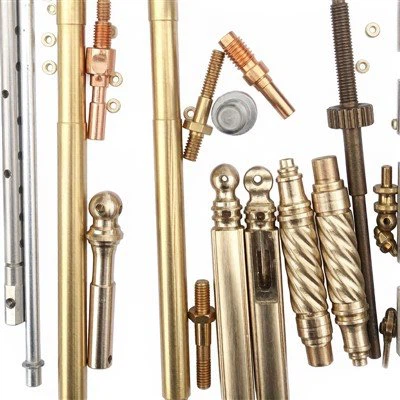
At the end of the day, the MOQ for CNC turn-mill parts isn’t a hard rule. It’s a calculation based on setup time, material, complexity, and shop capacity. The worst thing you can do is assume every shop has a MOQ of 100 or 500, because that’s not true. A good shop will be upfront with you about why their MOQ is what it is, and work with you if your needs are smaller. If you’re looking for a shop that will actually listen to your needs, whether you need 2 prototype parts or 500 production units, hit us up. We can break down costs, adjust MOQs where we can, and make sure your parts are machined correctly, on time, and without you breaking the bank.
CNC Turning Parts References
- Smith, J. (2022). Cost Optimization in Custom CNC Machining for Low-Volume Production. Journal of Manufacturing Processes, 56, 1214-1222.
- Aerospace Industries Association. (2021). Guidelines for CNC Machining of Complex Turn-Mill Components. AIA Manufacturing Standards Series.
- Metalworking Distributors Association. (2020). Material Waste Reduction Strategies for Custom Machining Operations. MDA Technical Bulletin 17-04.
Suzhou Huaquan Electromechanical Manufacturing Co., Ltd.
As one of the leading CNC turn-mill parts manufacturers in China, we warmly welcome you to buy bulk customized CNC turn-mill parts made in China here from our factory. If you have any enquiry about pricelist and free sample, please feel free to email us.
Address: No.7550 Mudong Road, Hengjing Town, Wuzhong District, Suzhou City, Jiangsu Province, China
E-mail: Huaquan2005@outlook.com
WebSite: https://www.huaquancnc.com/
